






Introduction: Redefining the Dining Experience
Dominique Crenn, the French-born chef of Atelier Crenn in San Francisco, is widely celebrated for her innovative, poetic approach to cuisine. Yet what distinguishes her from many of her contemporaries is not only her mastery of flavor but her insistence that culinary experiences are inherently visual and artistic. For Crenn, food is more than sustenance—it is an expressive medium where taste, aesthetics, and narrative converge.
Her philosophy transforms the traditional notion of dining into a multi-sensory encounter, where each plate is a deliberate composition of color, texture, and form. Crenn’s approach challenges diners to engage not only with their taste buds but also with their sense of sight, emotion, and intellectual curiosity. In her vision, cuisine becomes a canvas, a storytelling device, and a reflection of philosophy.
This essay explores Dominique Crenn’s culinary philosophy with a focus on visual beauty and artistry, examining how her approach manifests in menu design, ingredient selection, plating, kitchen leadership, and the broader cultural impact of her work. Through detailed analysis, we will see how food becomes art and dining becomes an immersive aesthetic experience under Crenn’s vision.
I. Philosophical Foundations: Culinary Art as Expression
1. Beyond Taste
While flavor remains central, Crenn emphasizes that taste alone is insufficient to create a memorable dining experience. She views food as a multi-layered communication tool, where aroma, texture, and especially visual composition convey emotion, narrative, and meaning.
Crenn’s philosophy asserts that:
- A dish should evoke feeling and reflection.
- Visual design enhances perception of taste by priming the diner’s senses.
- Food can function as both sustenance and fine art, bridging gastronomy and creative expression.
2. Influences on Her Vision
Crenn’s approach is shaped by:
- French culinary tradition, emphasizing technique and respect for ingredients.
- Visual arts and poetry, inspiring dishes that resemble miniature canvases or sculptural forms.
- Feminist and humanist values, encouraging intimacy, storytelling, and social consciousness in her work.
This foundation allows her to marry technical mastery with artistic sensibility, redefining what a high-end dining experience can be.
II. Menu Design as a Visual and Narrative Statement
1. Poetic Menus
Crenn’s menus are often poetic in structure, with each course functioning as a narrative or chapter. The textual presentation on paper mirrors her visual philosophy:
- Names of dishes evoke memory, nature, or personal history.
- Layouts suggest a progression or journey, guiding diners through taste and visual perception.
- Artistic descriptors prepare diners to approach each plate as an experience rather than a transaction.
By integrating visual and linguistic artistry, Crenn transforms menu design into a philosophical and aesthetic introduction to the meal.
2. Conceptual Continuity
Her menus maintain conceptual cohesion, ensuring that ingredients, plating, and flavor evolution align with an overarching story. For example:
- Seasonal ingredients are selected not only for taste but also for color, shape, and textural contrast.
- Courses progress in visual narrative, from delicate minimalist designs to more complex, layered presentations.
This approach emphasizes that culinary design begins long before plating, rooted in intention, creativity, and storytelling.
III. Ingredient Selection: Palette of the Artist
1. Ingredients as Colors and Textures
Crenn selects ingredients not solely for flavor but as tools of artistic expression:
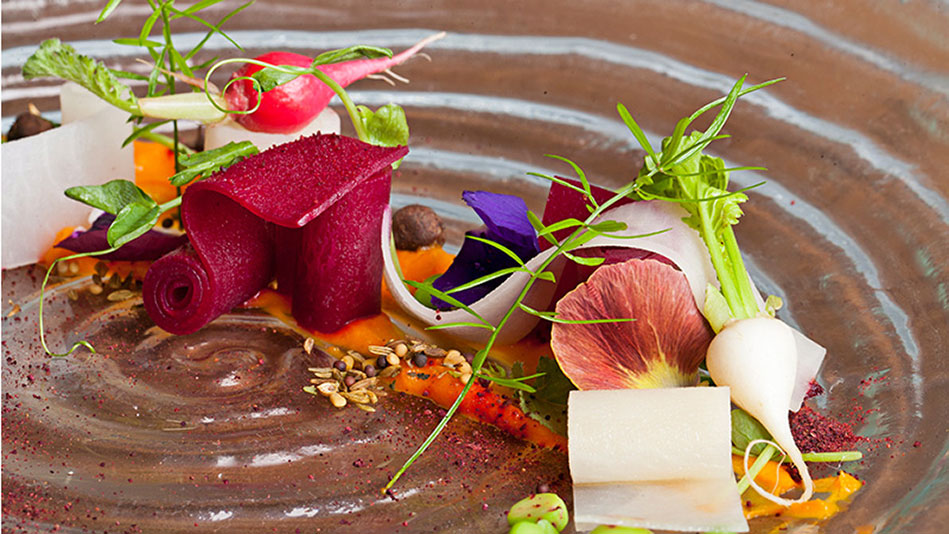
- Vibrant vegetables and edible flowers act as natural pigments.
- Varied textures—crisp, creamy, gelatinous—function like sculptural elements on the plate.
- Seasonal and local sourcing ensures that colors and forms are authentic and contextually meaningful.
Each ingredient serves a dual purpose: culinary and aesthetic, reflecting Crenn’s belief that food is both nourishment and visual storytelling.
2. Sustainability as Artistic Integrity
Ethical sourcing and sustainability are integral to her philosophy:
- Locally grown produce supports freshness and visual vibrancy.
- Minimizing waste enhances conceptual clarity, as each element on the plate carries intentional significance.
- Collaborating with artisan producers aligns with values-driven aesthetics, creating dishes that are visually and ethically harmonious.
Sustainability, therefore, reinforces artistry by ensuring every visual and taste element is thoughtfully chosen.
IV. Plating as Visual Storytelling
1. Principles of Visual Composition
Crenn approaches plating as a fine art discipline, drawing inspiration from painting and sculpture:
- Balance and asymmetry: Plates often combine structured elements with fluid, organic forms.
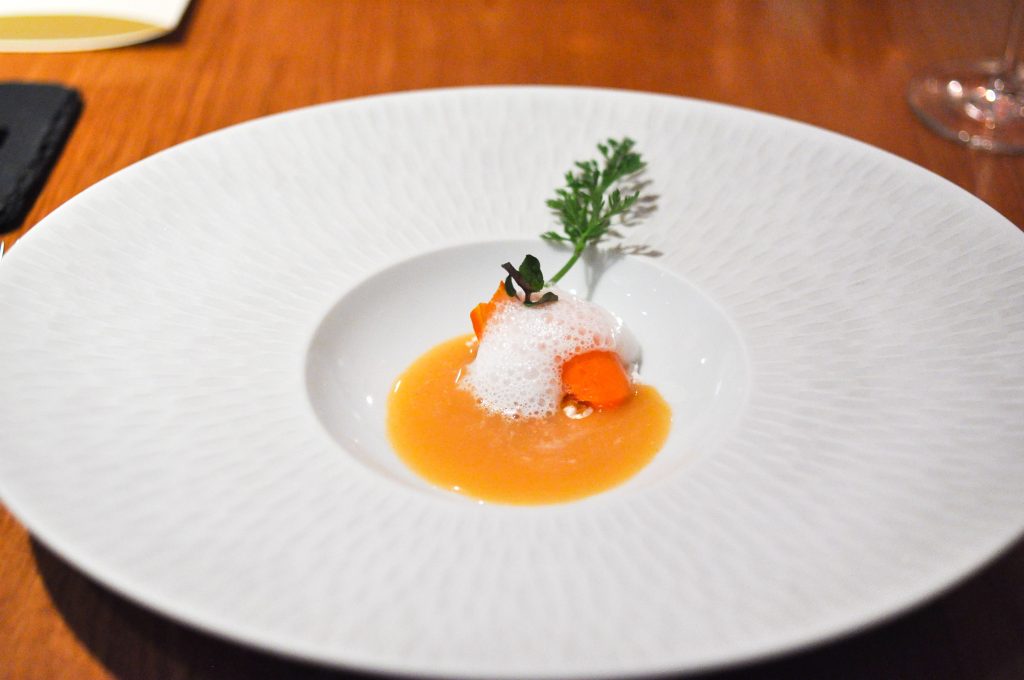
- Negative space: Careful use of empty space draws attention to the focal points of the dish.
- Color harmony and contrast: Complementary and contrasting colors guide the eye and evoke emotional responses.
Through these principles, each plate functions as a miniature canvas, inviting diners to appreciate form and composition alongside flavor.
2. Evoking Emotion Through Design
Crenn’s dishes often evoke poetic or emotional resonance:
- Natural, flowing arrangements suggest connection with nature.
- Abstract forms encourage reflection on memory, identity, or movement.
- Interactive or surprising elements provoke curiosity and engagement, creating a dynamic sensory experience.
Her plating philosophy demonstrates that visual beauty is inseparable from the emotional impact of food.
3. Multi-Sensory Integration
In addition to sight, Crenn designs plates to engage other senses:
- Aroma guides expectation and enhances perceived taste.
- Texture creates visual and tactile interplay.
- Sound (e.g., crisp elements) adds a performative dimension to the meal.
Crenn’s holistic approach ensures that artistry is not limited to appearance but integrates all sensory modalities, enhancing the overall dining experience.
V. Feminist Philosophy Interwoven with Artistic Vision
1. Redefining the Culinary Stage
Crenn’s artistic philosophy is intertwined with her feminist approach:
- She challenges the male-dominated hierarchy of fine dining by asserting the validity of emotion, intuition, and storytelling.
- Her emphasis on visual beauty reflects traditionally undervalued skills—attention to detail, empathy, and aesthetic sensitivity—qualities often associated with women but historically marginalized in professional kitchens.
2. Mentorship and Leadership
Crenn fosters inclusive, creative kitchens, mentoring women and underrepresented groups to:
- Contribute to visual and conceptual design.
- Develop individual artistic voices.
- Engage with culinary expression as both technical mastery and creative autonomy.
Through this, she institutionalizes artistry and feminist values, ensuring that visual and philosophical dimensions are central to professional practice.
VI. Case Studies of Iconic Visual Dishes
1. “A Song of Sea and Sky”
- Represents a narrative journey through color, texture, and form.
- Utilizes edible flowers, microgreens, and contrasting textures to evoke a miniature landscape.
- Demonstrates how plating conveys story and emotion beyond taste.
2. “Memory of Childhood”
- Incorporates nostalgic ingredients arranged with playful geometric composition.
- Engages sight, smell, and texture to trigger personal reflection and emotional resonance.
- Illustrates the intersection of culinary artistry, personal narrative, and philosophical intent.
3. Seasonal Menus
- Each course is visually crafted to reflect environmental context, demonstrating Crenn’s integration of nature, sustainability, and aesthetics.
- Plates resemble art installations, transforming dining into a gallery-like experience.
VII. The Cultural and Artistic Impact of Crenn’s Philosophy
1. Redefining Fine Dining
Crenn challenges traditional fine dining norms by emphasizing:
- Artistic expression over purely technical virtuosity.
- Narrative and emotional resonance alongside flavor.
- Ethical, feminist, and aesthetic integration as central values.
Her approach has inspired chefs worldwide to consider plating, storytelling, and sensory engagement as integral to gastronomy.
2. Public Perception and Influence
Through interviews, media appearances, and public lectures, Crenn advocates for:
- Recognition of culinary artistry as equal to traditional visual arts.
- Elevation of emotional and narrative dimensions in dining experiences.
- A reimagining of the chef’s role as artist, philosopher, and social innovator.
Her work demonstrates that the future of gastronomy values holistic creativity, where visual impact and emotional engagement are as critical as flavor.
VIII. Challenges in Artistic Culinary Philosophy
- Balancing aesthetic ambition with operational feasibility in high-volume settings.
- Ensuring that visual artistry complements, rather than overwhelms, taste and texture.
- Navigating expectations of traditional fine dining while innovating toward philosophically driven design.
Crenn’s success illustrates that careful integration of artistry, narrative, and philosophy can elevate cuisine without compromising functionality or flavor.
IX. Conclusion: Cuisine as Multi-Sensory Art
Dominique Crenn’s culinary philosophy exemplifies a paradigm where taste is inseparable from visual beauty, narrative, and emotion. Her approach demonstrates that:
- Food can function as fine art, engaging sight, touch, and emotion alongside flavor.
- Plating is a medium for storytelling, where each dish communicates narrative, philosophy, and cultural context.
- Culinary leadership can embrace feminist, ethical, and aesthetic principles, redefining what it means to be a chef in the modern era.
In Crenn’s vision, dining is no longer a mere act of consumption but a holistic sensory and intellectual experience. By prioritizing visual beauty, artistry, and multi-sensory engagement, she inspires chefs, diners, and the gastronomic world to see cuisine not just as sustenance but as living art.
Dominique Crenn reminds us that the charm of food lies as much in its beauty and artistry as in its flavor, demonstrating the profound impact of a chef’s philosophy on culture, perception, and human experience.