






Introduction
The evolution of cuisine in the twenty-first century is inseparable from science. While cooking has historically relied on tradition, intuition, and craftsmanship, contemporary culinary innovation increasingly employs the scientific method to explore, manipulate, and redefine food. From molecular gastronomy to experimental texture creation, science provides chefs with tools to understand and transform ingredients in ways that were previously unimaginable.
The scientific method—rooted in observation, hypothesis, experimentation, and analysis—has enabled a systematic approach to cooking that goes beyond trial and error. Chefs can now study the chemistry and physics of food, predict outcomes, and craft experiences that balance taste, texture, aroma, and visual impact. This paradigm shift challenges traditional boundaries, reshaping the sensory, nutritional, and cultural dimensions of dining.
This essay examines how the scientific method has redefined food’s form and texture. It explores historical context, key scientific principles, pioneering techniques, the role of chemistry and physics, case studies from leading chefs, and cultural and ethical implications. By integrating science into gastronomy, contemporary cuisine is not only a sensory experience but also a laboratory for exploration and creativity.
1. Historical Context: Science Meets Cuisine
1.1 Pre-Modern Science in Cooking
Even before formal scientific methodology, cooks experimented with techniques based on observation. Early examples include:
- Boiling, roasting, and fermentation methods derived from empirical experience.
- Preservation techniques, such as salting, smoking, and curing, optimized through trial and observation.
- Combining ingredients for complementary flavors based on sensory feedback.
These practices were intuitive but laid the groundwork for a more systematic approach.
1.2 Emergence of Modernist Cuisine
The late twentieth century marked a shift toward applying scientific principles explicitly. Chefs such as Ferran Adrià, Heston Blumenthal, and Grant Achatz began using chemistry, physics, and biology to:
- Understand molecular interactions that create texture and flavor.
- Employ controlled techniques like sous-vide to manipulate temperature and moisture precisely.
- Deconstruct classic dishes and rebuild them in innovative forms.
This intersection of science and cooking initiated the molecular gastronomy movement, fundamentally altering culinary philosophy.
2. Principles of the Scientific Method in Gastronomy
2.1 Observation and Hypothesis Formation
The scientific method begins with careful observation of ingredients, reactions, and sensory outcomes. Chefs observe:
- How heat affects proteins, starches, and fats.
- How pH influences color, flavor, and texture.
- How emulsions and foams stabilize or collapse under different conditions.
From these observations, hypotheses are formulated, for example: “If I reduce water content in this foam, it will retain its shape longer.”
2.2 Controlled Experimentation
Testing hypotheses requires reproducible techniques and careful measurement. Chefs conduct experiments with:
- Temperature-controlled baths (sous-vide).
- Precision mixers and blenders for controlled aeration.
- Gelling agents and stabilizers to manipulate viscosity.
Through iterative experimentation, chefs refine methods to achieve desired textures and forms consistently.
2.3 Analysis and Iteration
Data from experiments—whether chemical, physical, or sensory—inform adjustments. This iterative cycle mirrors laboratory science:
- Test a method.
- Record results, noting successes and failures.
- Modify variables (temperature, pH, ingredient ratio) for optimization.
- Repeat until the desired outcome is reproducible.
This rigorous approach ensures reliability and predictability in culinary innovation.
3. Redefining Food Texture
3.1 Molecular Interactions and Texture
Texture, or mouthfeel, is determined by molecular interactions among proteins, carbohydrates, and fats. Understanding these interactions allows chefs to manipulate form and consistency:
- Gelation: Proteins and polysaccharides form networks that create solid or semi-solid textures.
- Emulsification: Oil and water mixtures stabilized with lecithin or other agents produce smooth, creamy textures.
- Aeration: Incorporating air via foams, meringues, or siphons changes volume and perceived lightness.
3.2 Freeze-Drying and Cryogenic Techniques
Modern chefs use extreme temperatures to redefine texture:
- Freeze-drying removes water without collapsing structure, producing crunchy textures from previously soft ingredients.
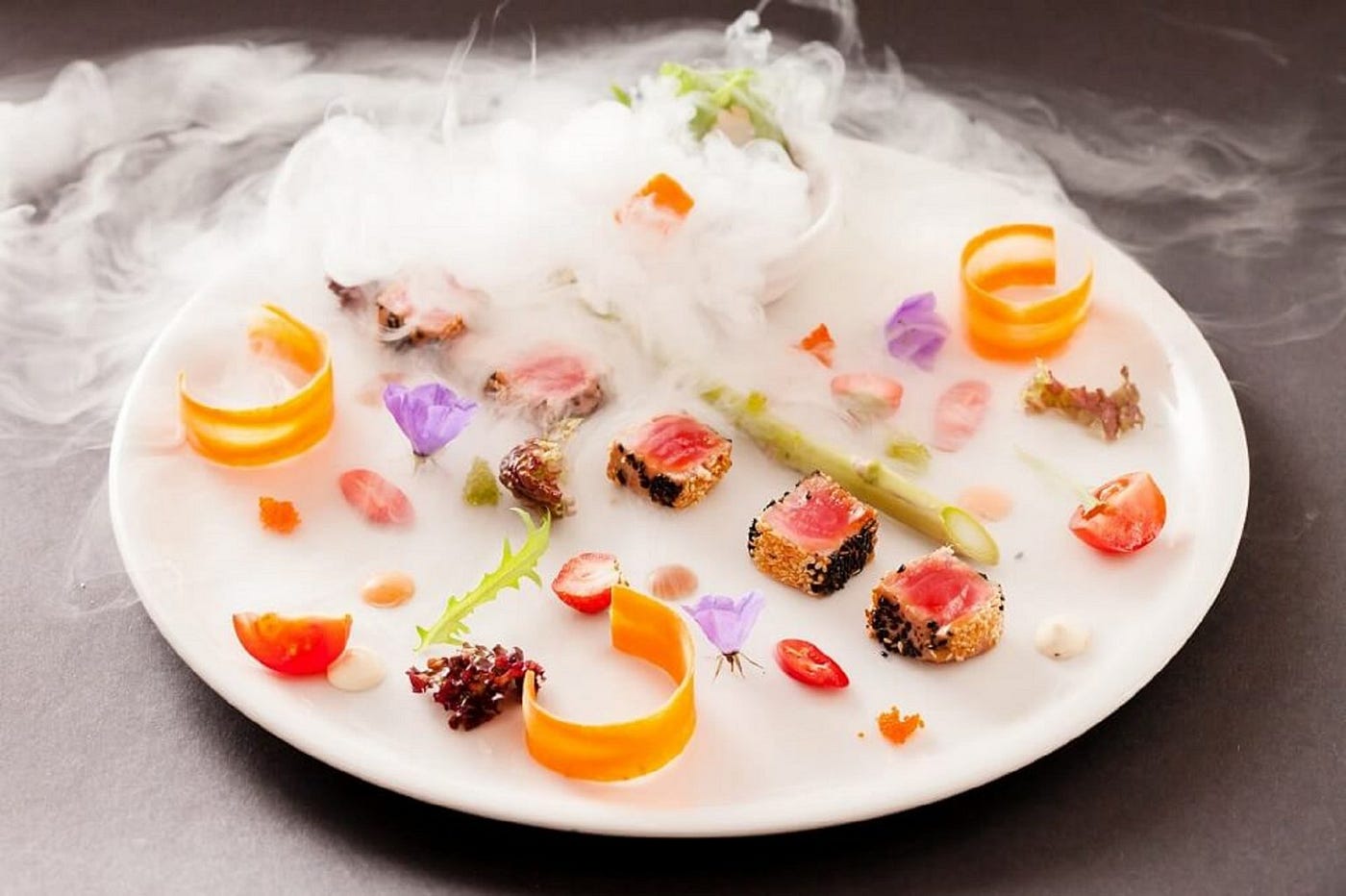
- Liquid nitrogen can instantly freeze ingredients, creating delicate crystalline textures or vapor effects.
These techniques exemplify the power of science to generate novel sensory experiences.
4. Reimagining Form Through Science
4.1 Spherification and Gelification
Spherification, a hallmark of molecular gastronomy, encapsulates liquids in gel membranes to create spheres resembling caviar. This technique:
- Preserves liquid flavor while transforming form.
- Offers novel presentation possibilities.
- Enhances tactile experience and interaction with food.
Similarly, gelification allows chefs to create solid shapes from purees or broths, enabling abstraction of familiar flavors into unexpected forms.
4.2 Deconstruction and Reconstruction
Scientific methodology allows classic dishes to be deconstructed and reconstructed with precision:
- A traditional dessert can be separated into multiple textures and flavors served simultaneously.
- Temperature, viscosity, and molecular stability are calculated to maintain coherence and flavor balance.
This approach transforms cuisine into a multi-sensory experience, blending familiarity and surprise.
5. Case Studies of Pioneering Chefs
5.1 Ferran Adrià and El Bulli
Adrià’s work epitomizes the application of science to cuisine:
- Invented techniques such as espuma, foams created using siphons.
- Emphasized deconstruction to isolate and intensify flavors.
- Conducted extensive experimentation, documenting results to refine methods systematically.
His methodology mirrored laboratory protocols, transforming cooking into reproducible, experimental practice.
5.2 Heston Blumenthal and Multi-Sensory Experience
Blumenthal integrates physics and chemistry to manipulate texture, sound, and aroma:
- Bacon-and-egg ice cream demonstrates flavor combination through temperature inversion.
- “Meat fruit” creates visual trickery using gels to mimic appearance while preserving taste.
Blumenthal’s scientific approach emphasizes the experiential dimension of cuisine.
5.3 Grant Achatz and The Art of Precision
Achatz’s work at Alinea showcases precision in form and texture:
- Uses gels, foams, and edible films to create abstract presentations.
- Combines sensory science with artistic composition.
- Iteratively tests form and mouthfeel to optimize multi-sensory impact.
His practice exemplifies the intersection of culinary art and scientific rigor.
6. Flavor Perception and Sensory Science
6.1 Multisensory Integration
Flavor is not just taste; it is the result of:
- Gustatory signals (sweet, sour, bitter, salty, umami).
- Olfactory signals (volatile compounds).
- Texture and temperature (mouthfeel).
- Visual cues (color, presentation).
Scientific understanding of these interactions allows chefs to manipulate perception, creating surprising yet harmonious experiences.
6.2 Cognitive Psychology and Expectation
Expectation shapes flavor perception. By altering texture or form, chefs challenge preconceptions, enhancing engagement and enjoyment.
- Example: Presenting a sweet fruit in savory form creates cognitive surprise.
- Science provides the tools to balance novelty with recognizability.
7. Chemistry of Taste and Texture
7.1 Protein Denaturation
Controlled heating or acidification denatures proteins, transforming texture:
- Sous-vide precision allows meat to maintain moisture while achieving desired tenderness.
- Egg proteins can be manipulated into custards or foams with exact texture.
7.2 Carbohydrate Gelation and Crystallization
Understanding sugar crystallization enables control over candy, meringue, and dessert textures. Polysaccharides, starches, and hydrocolloids allow chefs to create gels, foams, and aerated structures.
7.3 Lipid Interactions
Fats influence flavor release, mouthfeel, and visual appeal. Scientific manipulation—emulsification, clarified butter, or nitrogen-infused oils—enhances both flavor and texture.
8. Ethical and Cultural Implications
8.1 Sustainability Through Science
Scientific techniques can reduce food waste and improve resource efficiency:
- Transforming by-products into novel textures or purees.
- Fermentation to extend shelf life.
- Molecular manipulation to optimize ingredient utilization.
8.2 Cultural Reinterpretation
Applying science to traditional dishes can spark debates about authenticity. Ethical practice requires:
- Respect for culinary heritage.
- Balancing innovation with cultural sensitivity.
9. The Future of Scientific Culinary Innovation
9.1 Integration of AI and Computational Gastronomy
Artificial intelligence predicts flavor pairings, textural compatibility, and molecular interactions, expanding the possibilities of scientific cuisine.
9.2 Nutritional Optimization
Science enables precise nutrient control without compromising flavor, supporting health-conscious and functional culinary design.
9.3 Cross-Disciplinary Collaboration
Collaborations with chemists, physicists, and sensory scientists will continue to advance the boundaries of food form, texture, and experience.
Conclusion
The application of the scientific method has redefined the very essence of food, transforming the culinary arts into a disciplined yet creative laboratory. By understanding molecular interactions, sensory perception, and ingredient properties, chefs can manipulate form and texture with unprecedented precision. This approach preserves respect for ingredients while expanding the boundaries of flavor, presentation, and experience.
Science in gastronomy is not about replacing tradition but about enhancing understanding. It enables chefs to create multi-sensory narratives that challenge expectation, surprise the palate, and redefine what dining can be. As technology, chemistry, and culinary artistry continue to converge, the scientific method promises a future in which food is simultaneously a source of nourishment, aesthetic pleasure, and intellectual exploration.
By embracing science, chefs transform the kitchen into a space of experimentation, creativity, and discovery, ensuring that the art of food continues to evolve in form, texture, and meaning.